
Proceedings of the LACCEI International Multi-Conferences
“The Latin American and Caribbean Consortium of Engineering Institutions, LACCEI”, is a non-profit organization consisting of institutions that offer academic programs in Engineering and Technology with the goal of collaborating with other LACCEI partners. The word “institution” includes universities, colleges and schools.
Announcements
2026-06-17
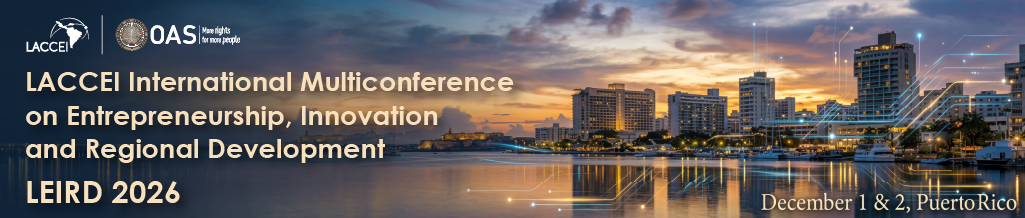
The LACCEI LEIRD 2026 Multiconference on Entrepreneurship, Innovation and Regional Development will be held in San Juan, Puerto Rico on December 1-3, 2026 (hybrid format).
Read more about LEIRD 2026 Multiconference - San Juan, Puerto Rico
Current Issue
Vol. 1 No. 14 (2026): LACCEI 2026
Articles
-
Statistical Analysis of Student Admission to the National Polytechnic School’s Leveling Course in the 2024-B and 2025-A Academic Periods.
This study provides a descriptive–comparative characterization of the cohorts admitted to the Leveling Course at the Escuela Politécnica Nacional (EPN) following the implementation of the new insti... -
Nutrient-Enriched Biochar as a Soil Amendment for Tropical Soils: A Review of Its Impacts and Potential in Sustainable Agriculture
Biochar is a carbon-rich material, such as wood or agricultural or livestock waste, which, when pyrolyzed, acquires characteristics of great interest to agriculture. These include increased microbi... -
Regenerative Urbanism and Ecological Resilience in Sechura: A Model Adapted to the Coastal Arid Ecosystem
This article analyzes the formulation of a regenerative urbanism and ecological resilience model adapted to the coastal arid ecosystem of Sechura, in the Piura region of Peru, in response to the ho... -
Design of a Modular Mobile Robot with Active Suction for Glass Window Cleaning in Buildings
Window cleaning in high-rise buildings is a high-risk activity that demands automated solutions to ensure industrial safety and operational efficiency. This paper presents the design, prototyping, ... -
Computational modeling of a mass transfer measuring device
This article presents a Computational Fluid Dynamics (CFD) model of a mass‐transfer measurement device designed to characterise biomass properties using Fick’s second law of diffusion, enabling the... -
Comparative Analysis of Seismic Demand in Caribbean Countries: the Case of Venezuela and Dominican Republic
The purpose of this article is to evaluate the methods and criteria used to determine seismic demand according to the Venezuelan standard COVENIN 1756-1:2019 and the Dominican Republic's R-001 regu... -
AI in Higher EducationOpportunities and Challenges for Engineering Careers in Latin America and the Caribbean
The use of artificial intelligence (AI) tools is growing in many areas of human development, particularly in higher education. Among its benefits are personalized learning, adaptation of content an... -
Redesign of workplaces in a cargo transportation company to reduce occupational risks
The objective of the research was to reduce occupational risks by redesigning the work stations of a cargo transportation company”. The situation was diagnosed through physical, ergonomic and IPERC... -
Employability and Perceived Competencies among Engineering Graduates: Evidence for International Accreditation (EUR-ACE)
Employability and the perception of competency development among graduates constitute key inputs for accreditation and quality improvement in engineering programs. This study analyzes the results o... -
Emotional mediation by the teacher in virtual learning: A key correlate of academic self-efficacy in engineering education
Emotional mediation provided by university professors is often considered unimportant in science and engineering degree programs; however, evidence suggests that it is one of the most significant f... -
Evaluation of Meteorological Variables and Their Influence on Air Quality at the La Oroya Metallurgical
The present research project aims to evaluate environmental air quality parameters and analyze the influence of meteorological variables within the district of La Oroya, Yauli Province, Junín Depar... -
IoT System with Incentive Mechanisms for Electricity Consumption Control
The objective of this study was to determine the effect of an IoT system with incentive mechanisms on residential electricity consumption control. The research had a quantitative approach and a lon... -
Mobile Application for Citizen Engagement with Urban Patrols in Cajamarca
pre-experimental design with pre- and post-tests, using a convenience sample of 60 participants (40 citizens and 20 patrol members). The app, developed with SCRUM, Android Studio, Kotlin, and Fireb... -
Reflective analysis of ethical practices through manipulation and social responsibility in design: a Systematic Literature Review
Abstract- This systematic literature review aims to analyze ethical practices related to manipulation and social responsibility in design in order to identify pedagogical approaches that foster mor... -
Student Engagement in Engineering Education Through Video Learning and Virtual Learning Objects
Student engagement remains a relevant challenge in engineering education, particularly in courses that require strong conceptual understanding and sustained cognitive effort. This study analyzes en... -
Technologies for Transforming Fermented Beverages from Liquid to Powder: A Systematic Literature Review
The interest in converting fermented beverages into powder has increased due to the need to extend shelf life, facilitate transport, and preserve bioactive compounds. This process requires maintain... -
Evaluation of ergonomic risk factors and their relationship with musculoskeletal disorders in the construction sector: A systematic review (2020-2025)
Musculoskeletal disorders (MSDs) are one of the main work-related illnesses in the construction sector, where ergonomics is a challenge due to the handling of heavy loads, awkward postures, and rep... -
Atmospheric Water Generators (AWGs): An Alternative to Climate Change in Honduras.
Worldwide, millions of people face the devastating effects of water scarcity due to climate change. This is the case of the Central American Dry Corridor, where 3.5 million people are currently vul... -
Evaluation of the Thermal Performance of a Solar Heating System with Sensible Heat Storage in Water and Automatic Control
High-Andean regions exhibit a marked mismatch between the availability of solar radiation during the day and the demand for heating at night, which calls for systems capable of storing thermal ener... -
Chess Educational Platform Based on Artificial Intelligence for Strengthening Cognitive Abilities in Vulnerable Educational Contexts
The present study addresses the limitations in the development of cognitive and academic skills of students in vulnerable educational contexts by evaluating an educational chess platform based on a... -
Assessment of conditions for the digital modernization of the construction permit process in the Central District of Honduras
The process for obtaining construction permits in the Central District of Honduras is characterized by institutional fragmentation, long response times, and high administrative costs, placing the m... -
Simulation-Assisted Evaluation of Salt Purification for Industrial Textile Applications
The textile industry requires high-purity salt as a critical raw material for dyeing. However, in many developing countries, including Honduras, locally produced marine salt does not consistently m... -
More Than Points and Badges: Narrative Experiences and Quantitative Results in a Gamified Calculus Course.
Calculus teaching in engineering in Latin America faces challenges such as high failure rates and student disconnection. The study "More Than Points and Badges" analyses the impact of narrative gam... -
Structural design of flexible pavement with rubber addition in the city of Trujillo
The research aimed to determine the influence of recycled rubber on the structural design of the flexible pavement of Av. América Sur during the year 2025, contributing to safer and more sustainabl... -
Impact of virtual laboratories on the achievement of learning outcomes in basic engineering courses
The expansion of virtual laboratories in engineering education has sparked debate about the extent to which these environments truly contribute to achieving learning outcomes in introductory course...
